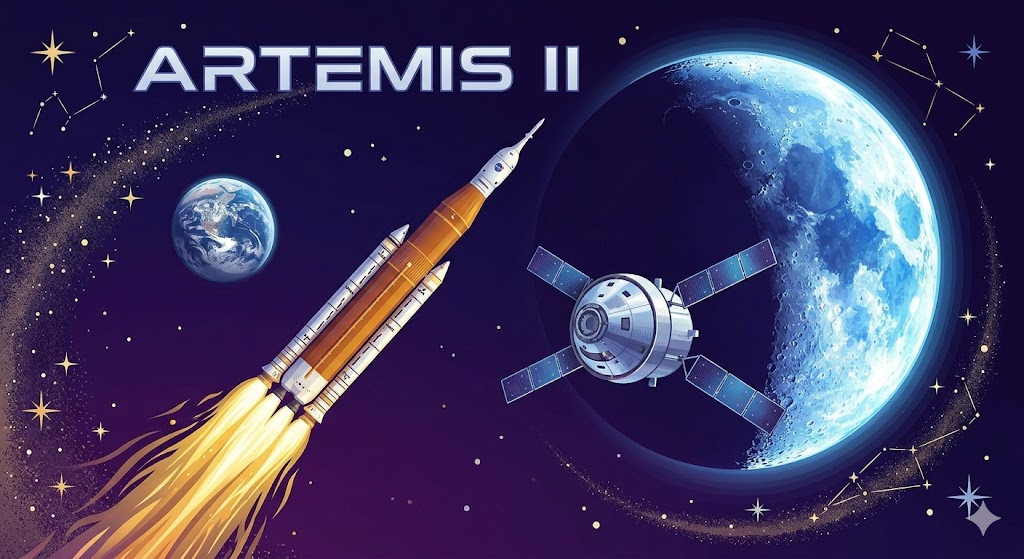
As of April 2026, the roar of the Space Launch System (SLS) and the successful launch of the Artemis II crew are fresh in the global consciousness. ✏️After months of anticipation, this historic mission, the first crewed voyage around the Moon in over 50 years, has just begun its journey. This paves the way for humanity’s sustained return to lunar exploration.
The ✏️ongoing validation of the Orion spacecraft’s life support systems, navigation, and re-entry capabilities is not just a technical achievement but a powerful reaffirmation of human ingenuity and our enduring drive to explore beyond Earth. With the mission underway and data beginning to pour in, the world now eagerly awaits Artemis III, the mission that will further test critical systems for a future lunar landing.
🛰️ Mission Underway: The Journey of Artemis II
The Artemis II mission, which ✏️launched on April 1, 2026, is a resounding success in its initial phases. The four-person crew—NASA astronauts Reid Wiseman, Victor Glover, Christina Koch, and Canadian Space Agency astronaut Jeremy Hansen—embarked on a roughly 10-day journey that will take them hundreds of thousands of miles from Earth.
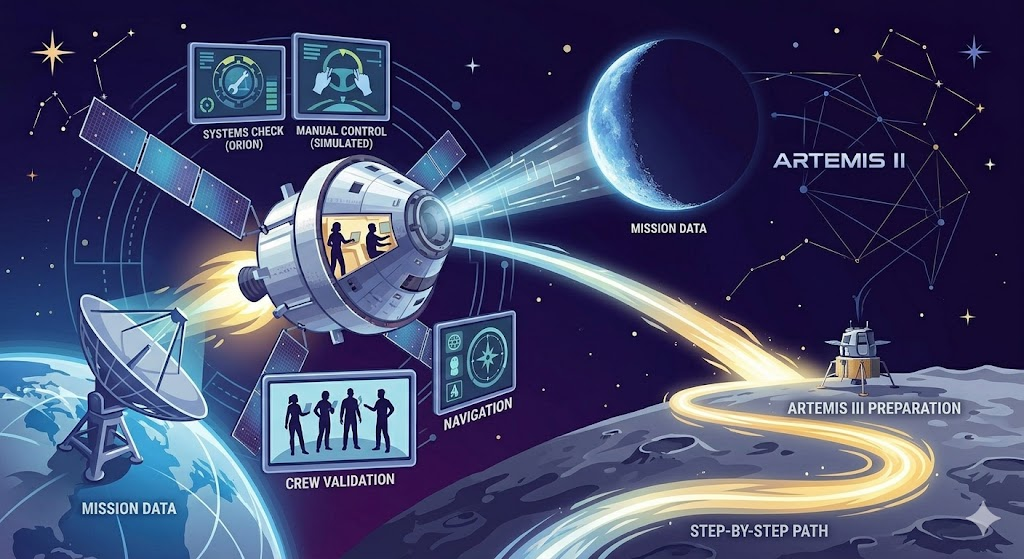
Their mission is to test the Orion spacecraft’s critical systems under deep-space conditions. This includes manual flight controls, life support, and communications, before it carries astronauts to the lunar surface on later missions.
The SLS rocket performed flawlessly, propelling the Orion capsule and its crew on a precise trajectory. This includes a lunar flyby, slingshotting them around the Moon before a controlled re-entry and splashdown. Every objective, from testing the heat shield’s resilience to verifying crew habitability, is being met, providing invaluable data for future deep-space endeavors.
🌟 Paving the Way: Artemis II’s Crucial Role for Artemis III and Beyond
Artemis II is not an end in itself, but a vital stepping stone in NASA’s ambitious Artemis program. The comprehensive testing and validation being performed by the crew and ground teams are significantly de-risking future missions, particularly the highly anticipated Artemis III.
The data collected on Orion’s performance, the crew’s experience with deep-space radiation, and the operational procedures for long-duration spaceflight are being meticulously analyzed to refine plans for the next missions.
✏️Artemis III is now slated for a 2027 launch. It will focus on testing rendezvous and docking procedures in low Earth orbit with commercial lunar landers, rather than a lunar landing.
The first crewed lunar landing is now planned for Artemis IV, targeted for early 2028. This methodical, step-by-step approach ensures that when humanity next sets foot on the Moon, it will be with the utmost confidence in our technology and readiness.
Beyond Artemis III and IV, the lessons learned from Artemis II will inform the development of a sustainable human presence on the Moon, ✏|including a lunar base, and future missions.
👨🚀 The Human Element: Meet the Trailblazing Crew of Artemis II
At the heart of Artemis II’s success are its four pioneering astronauts. Commander Reid Wiseman, Pilot Victor Glover, Mission Specialist Christina Koch, and Mission Specialist Jeremy Hansen embody the spirit of exploration. Their rigorous training, resilience, and teamwork are on full display throughout the mission.
✏️Glover is set to become the first person of color to travel around the Moon. ✏️Koch is set to become the first woman to do so. These achievements add profound historical significance.
Hansen, the first Canadian to venture beyond low Earth orbit, highlights the growing international collaboration in space.
Their detailed observations, live reports, and scientific contributions from lunar orbit will provide invaluable insights and inspire millions worldwide, reminding us that the human spirit remains the most critical component of space exploration.

🌌 A New Era of Exploration: What’s Next for NASA and Humanity?
With Artemis II firmly underway as a historic mission, the focus now shifts decisively to Artemis III and IV.
✏️Artemis III will conduct crucial tests in low Earth orbit, while Artemis IV promises to be even more monumental. Two astronauts will land near the Moon’s South Pole, a region believed to harbor significant water ice and other resources crucial for future lunar outposts. This will not only mark humanity’s return to the lunar surface but also initiate a new era of scientific discovery and resource utilization.
Looking further ahead, the Artemis program envisions a sustained human presence on the Moon, supported by a lunar base and potentially commercial partnerships. These lunar endeavors are not just about the Moon; they are crucial preparatory steps for humanity’s ultimate long-term goal: sending astronauts to Mars. Artemis II is proving we can go back; Artemis IV will show we can stay, setting the stage for even grander cosmic journeys.